

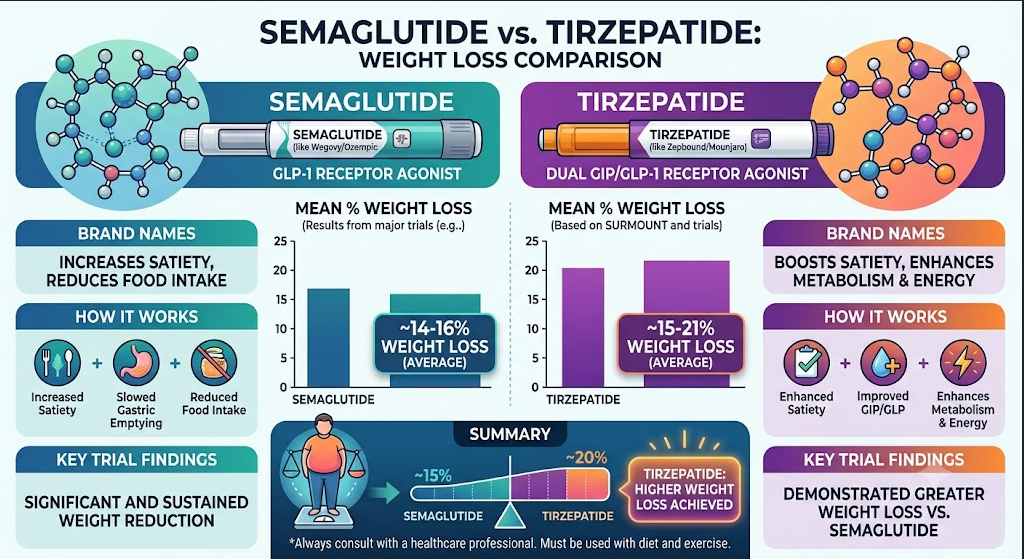
If weight loss is your main goal, you’ve probably narrowed your search down to two names: semaglutide (Wegovy, Ozempic) and tirzepatide (Zepbound, Mounjaro). Both are injectable medicines that have helped many people lose significant weight — but until recently, doctors could only compare them indirectly, using data from separate studies.
That changed with a landmark head-to-head trial. Here’s what the actual patient data shows about which medicine helped people lose more weight, and what that means for you.
Key Takeaways
- In a direct head-to-head trial (SURMOUNT-5), tirzepatide produced greater average weight loss than semaglutide over 72 weeks.
- Patients on tirzepatide lost an average of 20.2% of their body weight, compared with 13.7% with semaglutide.
- Tirzepatide patients were more likely to reach higher weight-loss milestones (10%, 15%, 20%, 25%+).
- Both medicines are effective and FDA-approved — tirzepatide’s edge in this trial doesn’t make semaglutide ineffective.
- The right choice depends on your health history, side-effect tolerance, and doctor’s guidance, not the trial averages alone.
What Is Semaglutide?
Semaglutide is a GLP-1 (glucagon-like peptide-1) receptor agonist. It mimics a natural gut hormone that slows digestion, reduces appetite, and helps regulate blood sugar. It’s sold as Ozempic (diabetes) and Wegovy (weight management), available as a weekly injection or, more recently, a daily oral tablet.
What Is Tirzepatide?
Tirzepatide is a newer dual GIP/GLP-1 receptor agonist — meaning it activates two gut hormone pathways instead of one. It’s sold as Mounjaro (diabetes) and Zepbound (weight management), currently available only as a weekly injection.
The extra GIP pathway is believed to enhance fat metabolism and appetite control beyond what GLP-1 activation alone achieves, which is the leading theory behind tirzepatide’s stronger weight-loss results in recent trials.
The Head-to-Head Trial: SURMOUNT-5
For years, semaglutide and tirzepatide were compared only indirectly, since they were tested in separate trials with different patient groups. That changed with SURMOUNT-5, the first randomised, head-to-head trial directly comparing the two medicines in the same population, published in the New England Journal of Medicine.
Trial design:
- 751 adults with obesity or overweight, plus at least one weight-related condition (such as high blood pressure or high cholesterol)
- No participants had diabetes
- Each person received the maximum tolerated dose of either tirzepatide (10 mg or 15 mg) or semaglutide (1.7 mg or 2.4 mg) once weekly
- Treatment lasted 72 weeks
Which Medicine Helped Patients Lose More Weight?
The results were clear-cut on the primary measure of weight loss:
| Result at 72 Weeks | Tirzepatide | Semaglutide |
| Average % body weight lost | 20.2% | 13.7% |
| Average weight lost | 22.8 kg (~50 lbs) | 15.0 kg (~33 lbs) |
| Waist circumference reduction | 18.4 cm | 13.0 cm |
| Patients losing ≥25% of body weight | 31.6% | 16.1% |
| Patients losing ≥20% of body weight | Higher proportion | Lower proportion |
| Patients losing ≥10% of body weight | Higher proportion | Lower proportion |
In plain terms, patients taking tirzepatide lost, on average, nearly 47% more body weight than those taking semaglutide over the same 72-week period. Tirzepatide patients were also more likely to hit every major weight-loss milestone the researchers measured — not just the average.
Why Did Tirzepatide Perform Better?
Researchers point to tirzepatide’s dual-hormone mechanism as the most likely explanation. By activating both GIP and GLP-1 receptors, tirzepatide may produce a stronger combined effect on appetite suppression and fat breakdown than a medicine that targets only one pathway. That said, this remains an active area of research, and scientists continue to study exactly how GIP and GLP-1 activation interact in the body.
Beyond Weight: Other Health Improvements
Weight loss wasn’t the only outcome measured. Both medicines improved several cardiometabolic markers, including:
- Blood pressure (systolic and diastolic)
- Blood sugar control (HbA1c)
- Fasting insulin levels
- Triglycerides
- HDL (“good”) cholesterol
Improvements were seen with both medicines, but were generally somewhat greater in the tirzepatide group — consistent with its larger weight-loss effect, since many of these markers improve as excess weight decreases.
What About Side Effects?
Both medicines share a similar side-effect profile because they act through related hormonal pathways. The most common side effects for both include:
- Nausea
- Diarrhea or constipation
- Vomiting
- Stomach discomfort or bloating
- Reduced appetite
- Fatigue
One notable difference: in the SURMOUNT-5 trial, fewer patients on tirzepatide stopped treatment due to gastrointestinal side effects (2.7%) than on semaglutide (5.6%). This suggests tirzepatide may be somewhat easier for some patients to tolerate — though individual experiences vary, and some people do better on semaglutide.
Both Weight medicines also carry the same serious warnings, including an FDA boxed warning about a risk of thyroid C-cell tumours seen in animal studies, and precautions around pancreatitis, gallbladder issues, and dehydration-related kidney problems.
Important Limitations to Keep in Mind
Before assuming tirzepatide is automatically the “better” choice, it’s worth understanding a few limits of the SURMOUNT-5 trial:
- It was open-label — both patients and researchers knew which medication was being given, which can sometimes influence reported outcomes such as side effects or motivation.
- No participants had diabetes — results in people managing type 2 diabetes specifically may look somewhat different.
- Average results aren’t guaranteed results — some people lost more weight on semaglutide than the group average, and some lost less on tirzepatide. Individual response varies.
- Availability differs — semaglutide offers an oral tablet option, while tirzepatide is currently injection-only, which may affect which medicine is realistic for you.
So, Which Medicine Should You Choose?
Based on the current evidence, tirzepatide has shown a clear average weight-loss advantage over semaglutide in direct comparison. But “more weight loss on average” doesn’t automatically mean “the right choice for you.” Your doctor will typically weigh:
- Your medical history and any conditions that might favour one medicine over the other
- How well you tolerate gastrointestinal side effects
- Whether you prefer an injection or a tablet
- Your insurance coverage and out-of-pocket costs
- Your personal weight-loss and health goals
Lifestyle Habits That Support Either Medicine
Regardless of which medicine you’re prescribed, these habits can improve both comfort and results:
- Eat protein-rich, smaller meals to support fullness and protect muscle mass during weight loss
- Eat slowly since both medicines slow down digestion
- Stay hydrated, especially if experiencing diarrhoea or reduced appetite
- Limit greasy, high-fat meals early in treatment to reduce nausea
- Include resistance exercise to help preserve lean muscle as you lose weight
- Keep regular follow-up appointments so your dose can be adjusted safely
When to See a Doctor
Contact your healthcare provider promptly if you experience:
- Severe or persistent abdominal pain
- Signs of a serious allergic reaction, such as facial swelling or difficulty breathing
- A lump or swelling in the neck, or persistent hoarseness
- Signs of dehydration, such as dizziness or a rapid heartbeat
- Symptoms of low blood sugar, especially if also taking insulin
Frequently Asked Questions
- Which medicine causes more weight loss, semaglutide or tirzepatide? In a direct head-to-head trial, tirzepatide produced greater average weight loss than semaglutide — 20.2% versus 13.7% of body weight over 72 weeks. However, individual results vary, and semaglutide still produces significant weight loss for many patients.
- Why does tirzepatide cause more weight loss than semaglutide? Tirzepatide activates two gut hormone pathways (GIP and GLP-1), while semaglutide activates only GLP-1. This dual mechanism is thought to produce a stronger combined effect on appetite and fat metabolism, though researchers are still studying exactly how the two pathways interact.
- Is tirzepatide safe compared to semaglutide? Both medicines have similar safety profiles and share the same major warnings, including a boxed warning about thyroid tumor risk seen in animal studies. In one large trial, tirzepatide had fewer treatment discontinuations due to digestive side effects than semaglutide.
- How much weight can I expect to lose on tirzepatide vs semaglutide? Clinical trial averages showed about 20% body weight loss with tirzepatide and about 14% with semaglutide over 72 weeks, though individual results depend on dose, diet, activity level, and personal biology. These are trial averages, not guarantees.
- Can I switch from semaglutide to tirzepatide? Switching is possible but should only be done with medical supervision, since dosing isn’t directly interchangeable between the two medicines and your doctor will need to determine an appropriate starting dose for you.
- Do insurance cover tirzepatide and semaglutide the same way? Coverage varies by insurer, country, and whether the prescription is for diabetes or weight management, since these uses are sometimes covered under different rules. Check with your insurance provider for accurate details for your plan.
- Is tirzepatide available as a pill? Not yet widely. Tirzepatide is currently available only as a weekly injection, while semaglutide is available as both a weekly injection and a daily oral tablet.
- What are the main side effects of these weight loss medicines? Both commonly cause nausea, diarrhoea, constipation, and reduced appetite, particularly during the first few weeks of treatment or after a dose increase. These effects usually improve as the body adjusts.
- Is it safe to take these medicines long-term? Both have been studied for up to 2 years in clinical trials, with generally consistent safety profiles, though semaglutide has a longer overall history of use. Long-term treatment with either medicine should be monitored regularly by a doctor.
- What happens if I stop taking semaglutide or tirzepatide? Most people regain some weight after stopping either medicine, especially without continued lifestyle support, which is why many doctors recommend viewing these as long-term treatments rather than short-term fixes.
- Can I buy semaglutide or tirzepatide online without a prescription? No. Both medicines are prescription-only in the USA, UK, and Australia, and any legitimate pharmacy — online or in person — will require a valid prescription before dispensing either one.
- Which medicine is better for someone with type 2 diabetes? In diabetes-focused head-to-head research, tirzepatide produced greater reductions in blood sugar (HbA1c) than semaglutide. Both remain effective, FDA-approved treatment options, and the right choice depends on individual health factors that your doctor can help assess.
Conclusion
When it comes to raw weight-loss numbers, the evidence from direct head-to-head research is fairly clear: tirzepatide helped patients lose more weight than semaglutide over 72 weeks in the SURMOUNT-5 trial, with more patients reaching higher weight-loss milestones and fewer stopping due to digestive side effects. That said, semaglutide remains a genuinely effective, well-studied medicine — and for some patients, factors such as oral availability, cost, insurance coverage, or personal tolerance may make it the more practical choice.
The most reliable way to decide which medicine is right for you is a personalised conversation with your doctor, who can weigh the trial data against your own health history and goals.
This article is for general educational purposes only and is not a substitute for professional medical advice. Always consult a qualified healthcare provider before starting, stopping, or changing any medication.